1. List what you consider to be the three strengths of Ruby on Rails workshop series
a. Learn a new programming language for e-commerce
b. Learn the new kind of framework on software development
c. Practical the RoR skill on the workshops
2. List what you consider to be the three weaknesses of Ruby on Rails workshop series:
a. RoR version changes with its language, it is difficult to follow up.
b. Setup and configure the server will be difficult if no experience.
c. Difficult to classify if we should do both the “To do:” and “Challenge Problem:” or only “To do:”
3. List what aspects of Ruby on Rails workshop series that you found to be most difficult.
a.. Install and configure the server in the UNIX/Linux environment, it is not allowed in my workplace.
b. Instead of the text mode, if a GUI IDE introduced for RoR may improve the work for workshops.
c. The AJAX (not encounted before)
d. Lots of time used in the workshop
e. The work including exercises and workshops were too much for the part time student.
4. List what improvements could be made to the Ruby on Rails workshop series:
a. Introduce the GUI IDE.
b. Clear clarify if we should work on both "To do:" and “Challenge Problem:” or else.
Free response and reflective questions:
5. The MVC framework separates three type of work at place. It is found to be effective framework for development.
6. No. It is because the RoR can give me challenges and fulfillment.
7. No further comments
Tuesday, May 19, 2009

Workshop 7: DEVELOPER’S THREAD (RED team)
Workshop 7
I would like to choose the UNIX platform to deploy the system. I have been using the Linux platform to provide service as production server such as Webmail, FTP in my workplace for years. The stability and the performance of the system are excellent. In terms of the system maintenance, the patch or fix packages release rapidly when bugs were found. Absolutely, it is important that it is free.
I would like to use the Mongrel and Mongrel cluster for deployment. In my experience in the workshop with InstantRails, it is a easy to use plugins to the RoR. Furthermore, Mongrel is a single-threaded application (Wikipedia 2009), with the management of the Mongrel with Mongrel-cluster plugins, the load of the system will be balanced on production server.
Microsoft platforms and development platform like JAVA and JRuby are not considered. Although it is more easy to configure the system with Microsoft platforms, the stability is not as well as UNIX for deployment as production server. JAVA and JRuby are not choosen. Although JAVA or JRuby can provide cross platform capability, but the performance of the system may not to be as good as just using the Apache with Mongrel. The other reason is that WiFi are popular, people can use their PDA phones or Smartphone to go Internet and browse the website directly deploying JAVA like platform may lead a slow performance on the client side.
Reference:
Wikipedia (2009), Mongrel (web server), Retrieved 27 May 2009 form http://en.wikipedia.org/wiki/Mongrel_(web_server)
Debian (n.d.), Mongrel plugin to manage a cluster of Mongrel servers, Retrieved 27 May 2009 from http://packages.debian.org/zh-cn/squeeze/mongrel-cluster
I would like to choose the UNIX platform to deploy the system. I have been using the Linux platform to provide service as production server such as Webmail, FTP in my workplace for years. The stability and the performance of the system are excellent. In terms of the system maintenance, the patch or fix packages release rapidly when bugs were found. Absolutely, it is important that it is free.
I would like to use the Mongrel and Mongrel cluster for deployment. In my experience in the workshop with InstantRails, it is a easy to use plugins to the RoR. Furthermore, Mongrel is a single-threaded application (Wikipedia 2009), with the management of the Mongrel with Mongrel-cluster plugins, the load of the system will be balanced on production server.
Microsoft platforms and development platform like JAVA and JRuby are not considered. Although it is more easy to configure the system with Microsoft platforms, the stability is not as well as UNIX for deployment as production server. JAVA and JRuby are not choosen. Although JAVA or JRuby can provide cross platform capability, but the performance of the system may not to be as good as just using the Apache with Mongrel. The other reason is that WiFi are popular, people can use their PDA phones or Smartphone to go Internet and browse the website directly deploying JAVA like platform may lead a slow performance on the client side.
Reference:
Wikipedia (2009), Mongrel (web server), Retrieved 27 May 2009 form http://en.wikipedia.org/wiki/Mongrel_(web_server)
Debian (n.d.), Mongrel plugin to manage a cluster of Mongrel servers, Retrieved 27 May 2009 from http://packages.debian.org/zh-cn/squeeze/mongrel-cluster
Workshop 6: Enjoying the Ride: Web framework alternatives, scalability and flexibility

Figure 1. Generate the site

Figure 2. Result of site generation

Figure 3. Change the route

Figure 4. Welcome screen
At this stage, the file index.html in public folder is removed, the file index.erb in OTBS\app\views\site removed.

Figure 5. Screen after added link at the top of page

Figure 6. Screen after implementation of CSS

Figure 7. Change MySQL password and create database

Figure 8. Database structure at MySQL administrator

Figure 9. Register screen
Due to my computer system failure, it is required to rebuild the stuffs from scratch.
As the time constraint, the rebuild of the workshop was unsuccessful. I will do my best to try it again even passed the deadline of assessment.
I do not have any experience on writing AJAX program. According to the Wikipedia (2009), with the AJAX, the data exchange asynchronously between browser and server, the performance is much faster than always connected. The AJAX programming avoiding page reloads, that part of the screen is refreshed as it required. The load of the server reduced.
Reference:
Wikipedia (2009), Ajax (programming), Retrieved 27 May 2009 from http://en.wikipedia.org/wiki/Ajax_(programming)
Workshop 5: Admiring the scenery Forms, AJAX screen layout and mobile interfaces
I am joining the RED TEAM - DEVELOPER. It is because like to create programs, from concept to product.
Part A
1. Create the Rails application framework in the projects folder:

2. Running the application on localhost:3000 using the WeBrick ruby server (or Mongrel as alternative) and access via Web browser at http://localhost:3000/


3. Create the controller to make the application do an action. This is under the controller-action/model-view structure.


Result from browser

5. Create an action by editing and saving the mammal_controller.rb class in projects\animals\app\controllers using your text editor to add the method
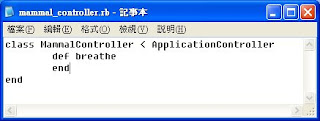
6. Start the WEBrick server and browse at http://localhost:3000/mammals/breathe where you will get a “missing template” message since it is missing a view for the breathe method.

7. Create and save a view in that directory by using a text editor to create a view called breathe.rhtml

Result from browser

8. Try Ruby code and HTML in the action view by using the <%....%> wrapper around the inserted Ruby code. Here are some snippets to try from workshop 4:

Result from browser

Part B
1. Create a new application called scenery in the same projects directory to demonstrate the use of an active view.

2. Create a controller called Demo in scenery\app\controllers
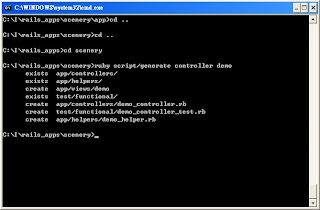
3. Add an action to demo_controller.rb as the method called rubycode


4. Add a view template - scenery\app\views\demo\rubycode.rhtml


Result at browser

8. Then modify and save the corresponding view template

9. Restart the Web server and navigate the browser

Part C
1. Create a new application called cabs in the same projects directory to demonstrate the use of an active view.

2. Create a controller called Vehicle in cabs\app\controllers

3. Add an action to vehicle_controller.rb as the method called cabtype

View result

6. Create a file in the public directory - \cabs\public called input.html

7. Edit the vehicle_controller.rb here is a start. The data in each form element in the Rails application can be accessed via its name and a hash called params

8. Edit the view template cabtype.rhtml

9. Start the Web server and go to the opening page of this application at http://localhost:3000/input.html

Result

10. Submit form data. What do you find?
I found error in the program. The if statement can not progress with the (=) equal to symbol when using boolean type of variable.
After fix the webpage and link. The information pass from webpage and to the controller vehicle_controller.rb and to the result page - cabtype.rhtml for output.
11. Report your progress or findings in your Developers Blog.
The select list use array. It is because the selection from user is the index value but not the text itself. So, the array is used to collect the text back from the index value.
Part A
1. Create the Rails application framework in the projects folder:

2. Running the application on localhost:3000 using the WeBrick ruby server (or Mongrel as alternative) and access via Web browser at http://localhost:3000/


3. Create the controller to make the application do an action. This is under the controller-action/model-view structure.


Result from browser

5. Create an action by editing and saving the mammal_controller.rb class in projects\animals\app\controllers using your text editor to add the method

6. Start the WEBrick server and browse at http://localhost:3000/mammals/breathe where you will get a “missing template” message since it is missing a view for the breathe method.

7. Create and save a view in that directory by using a text editor to create a view called breathe.rhtml

Result from browser

8. Try Ruby code and HTML in the action view by using the <%....%> wrapper around the inserted Ruby code. Here are some snippets to try from workshop 4:

Result from browser

Part B
1. Create a new application called scenery in the same projects directory to demonstrate the use of an active view.

2. Create a controller called Demo in scenery\app\controllers

3. Add an action to demo_controller.rb as the method called rubycode


4. Add a view template - scenery\app\views\demo\rubycode.rhtml


Result at browser

8. Then modify and save the corresponding view template

9. Restart the Web server and navigate the browser

Part C
1. Create a new application called cabs in the same projects directory to demonstrate the use of an active view.

2. Create a controller called Vehicle in cabs\app\controllers

3. Add an action to vehicle_controller.rb as the method called cabtype

View result

6. Create a file in the public directory - \cabs\public called input.html

7. Edit the vehicle_controller.rb here is a start. The data in each form element in the Rails application can be accessed via its name and a hash called params

8. Edit the view template cabtype.rhtml

9. Start the Web server and go to the opening page of this application at http://localhost:3000/input.html

Result

10. Submit form data. What do you find?
I found error in the program. The if statement can not progress with the (=) equal to symbol when using boolean type of variable.
After fix the webpage and link. The information pass from webpage and to the controller vehicle_controller.rb and to the result page - cabtype.rhtml for output.
11. Report your progress or findings in your Developers Blog.
The select list use array. It is because the selection from user is the index value but not the text itself. So, the array is used to collect the text back from the index value.
Monday, May 11, 2009
Exercise 26: End of the Line: Systems integration
I choose the Business process analysis.
2. Business process analysis
Organisations can use several systems to monitor, record business process transactions such as:
•Enterprise Resource Planning (ERP),
•Customer Relationship Management (CRM)
•Workflow Management,
These software systems store data on instances of business processes transactions and can be analysed using data or process mining (PM) and reverse business engineering (RBE). In the case of ERP systems, integration of all data and processes goes into a single database as system components – the ultimate integration notion, perhaps.
Summary:
I chose business process analysis and scattered bits together. According to the Sagebusiness.com (2008), "ERP systems for functions such as managing receivables, inventory, and finance, and CRM systems are used to manage contact relationships, cross-sells, and up-sells."
Although ERP and CRM are different systems, Sagebussiness.com (2008) stated that properly integration of the system increase the profitability and productivity than investment and efforts involved.
George (2008) suggested the following points for the system integrations:
1. Take a business process view of ERP-CRM integration
He suggested considering the benefit to the business than the individual business.
2. Determine how ERP-CRM integration can benefit end users
He suggested the users should gain improvement on experience the new integrated system.
3. Reduce fears around loss of control
He suggested that integration should reduce the duplication of the customer information.
4. Cultivating the right ERP-CRM integration team
According to the organization size, the integration team should be from different department with limited number of people to reduce conflicts.
5. Assigning process ownership for an ERP-CRM integration project
Due to the system is different in ERP and CRM, the new system should allow to manage different kind of data. The integration can be into single or multi instances strategies.
I don’t work on the ERP and CRM. As I studied the passages of system integration on both systems, when a relation of the planning of the resource to the customer needs, the "order-to-cash processes" (Sagebusiness.com 2008) leads the reduction of the cost. On the other hand, as the CRM can analysis for the market trend, the ERP can allocate more resources to the market that expanding for more profits.
Reference:
Walia S. (2008), CRM and E-Commerce: The Integration Payoff, Retrieved 25 May 2009 from http://www.crmbuyer.com/story/64103.html?wlc=1243405763
Sagebusiness.com.au (2008), ERP & CRM Integration Tips, Retrieved 25 May 2009 from http://www.sagebusiness.com.au/pg-news-erp-crm-software-integration-top-tips.seo
George L. (2008), Benefits of ERP-CRM integration, Retrieved 25 May 2009 from http://searchcrm.techtarget.com/generic/0,295582,sid11_gci1320412,00.html
2. Business process analysis
Organisations can use several systems to monitor, record business process transactions such as:
•Enterprise Resource Planning (ERP),
•Customer Relationship Management (CRM)
•Workflow Management,
These software systems store data on instances of business processes transactions and can be analysed using data or process mining (PM) and reverse business engineering (RBE). In the case of ERP systems, integration of all data and processes goes into a single database as system components – the ultimate integration notion, perhaps.
Summary:
I chose business process analysis and scattered bits together. According to the Sagebusiness.com (2008), "ERP systems for functions such as managing receivables, inventory, and finance, and CRM systems are used to manage contact relationships, cross-sells, and up-sells."
Although ERP and CRM are different systems, Sagebussiness.com (2008) stated that properly integration of the system increase the profitability and productivity than investment and efforts involved.
George (2008) suggested the following points for the system integrations:
1. Take a business process view of ERP-CRM integration
He suggested considering the benefit to the business than the individual business.
2. Determine how ERP-CRM integration can benefit end users
He suggested the users should gain improvement on experience the new integrated system.
3. Reduce fears around loss of control
He suggested that integration should reduce the duplication of the customer information.
4. Cultivating the right ERP-CRM integration team
According to the organization size, the integration team should be from different department with limited number of people to reduce conflicts.
5. Assigning process ownership for an ERP-CRM integration project
Due to the system is different in ERP and CRM, the new system should allow to manage different kind of data. The integration can be into single or multi instances strategies.
I don’t work on the ERP and CRM. As I studied the passages of system integration on both systems, when a relation of the planning of the resource to the customer needs, the "order-to-cash processes" (Sagebusiness.com 2008) leads the reduction of the cost. On the other hand, as the CRM can analysis for the market trend, the ERP can allocate more resources to the market that expanding for more profits.
Reference:
Walia S. (2008), CRM and E-Commerce: The Integration Payoff, Retrieved 25 May 2009 from http://www.crmbuyer.com/story/64103.html?wlc=1243405763
Sagebusiness.com.au (2008), ERP & CRM Integration Tips, Retrieved 25 May 2009 from http://www.sagebusiness.com.au/pg-news-erp-crm-software-integration-top-tips.seo
George L. (2008), Benefits of ERP-CRM integration, Retrieved 25 May 2009 from http://searchcrm.techtarget.com/generic/0,295582,sid11_gci1320412,00.html
Exercise 24: Virtual business worlds and cyberagents
1. Differentiate the various type of software agents
According to Ince (2004), There are eleven type of software agents and described as follows:
a. Chatterbots
converses with the user in some restricted form of natural language.
b. Commerce agents
In B2B environment, this agents process invoices, checking arrival of material for process, notifying the product arrival and create financial information.
c. Data management agents
Associated with corpora of data that processing text on web site into a summary.
d. Government agents
Used to search for government regulations or extracting government statistics.
e. News agents
Display the breaking news.
Search for specified news by user.
email the news story to user.
Personalize the newspaper according to users' preference.
f. Newsgroup agents
Sorting out, prioritise and display the posting according to the users keywords.
Search the FAQ list for answers to a specified question. Notify the user of the new information is discussed in newsgroup.
g. Shopping agents
Carry out tasks associated with the accessing of retail sites. It is used to compare prices on the retails sites and auction sites on the internet for the products.
h. Software agents
Carry out tasks associated with software
e.g. Notify for software update
i. Stock agents
Associated with the purchasing and selling stocks and shares.
j. Update agents
Notify the user when a change has occured which is of significance to the user
2. Describe how techniques such as artificial intellgence and statistical techniques are used in software agents.
Fuzzy agents is a kind of artificial intellgence which implements fuzzy logic. This agent uses a rule based system to deal and make decision with the conditions it adopt. (Wikipedia 2009)
In statistical techniques, the software agents uses data mining algorithms to analyse the rules and common behaviours from the information rich environments.
3. Identify various activities in e-commerce where software agents are curently in use.
According to Clurman, W., Foley, T., Guttman, R., Kupres, K. (1997), the following activities are currently in use.
i. Personalization
This is the sense in which it is literally an “agent” taking action in the interests of another just as a real estate agent is understood to represent the interests of a buyer or seller. The outcome of the agent’s primary task is controlled by specific information supplied by the user, the agent is personalized for that user.
ii. Brokering
Brokering is different from personalization in that brokering is the function of information retrieval and delivery, given personalized instructions. Again, the search engine that delivers query results is a simple example of a broker, as it gathers and delivers results based on personalized input. So-called “meta-indexes” perform this function on more than one data source.
iii. Negotiation
Negotiating agents may be empowered to execute transactions on behalf their users. The “program-trading” accepting and reviewing information supplied by the activity of an agent and determine the user threshold to make buying or selling decisions financial markets.
4. Computing ethics and bot programming case study: rocky
a.
An account username: train1 and password: train1 is obtained.

Figure 1. Login Screen

Figure 2. After login

Figure 3. Starting the bot

Figure 4. Normal Option
In the screen of normal option, the bot does not seems to know anything and does not response to the user typing. It always says "I don't understand that."

Figure 5. Say Option
In the screen with say option, the bot response, but it usually give uncertain or unexpect answer or asking unexpected questions.

Figure 6. emote Option
In the screen with emote option, the bot response, the response is much better especially on the postive and negative matter and illness . It still give some uncertain or unexpect answer or asking unexpected questions. When the answer from user is short. Sometimes it gives no response at all.

Figure 7. Stop the Rocky
c.
Accroding to Wikipedia (15 May 2009), ELIZA was a computer program of primitive natural language processing. It uses simple pattern matching techniques to response to its users.
As I chatted with the Rocky about, the Rocky is trying to match the pattern for postiive and negative attitude of the users. It seems not response the long and complex sentance well.
Reference:
Nwana H. S. (1996), Software Agents: An Overview, Retrieved 13 May 2009 from http://www.sce.carleton.ca/netmanage/docs/AgentsOverview/ao.html
Wikipedia (2009), ELIZA, Retrieved 18 May 2009 from http://en.wikipedia.org/wiki/ELIZA
Grossklags J., Schmidt C. (2003), Artificial Software Agents on Thin Double Auction Markets - A Human Trader Experiment, Retrieved 15 May 2009 from http://www.sfb504.uni-mannheim.de/~cschmidt/paper/IAT2003-grossklags-schmidt.pdf
Wroclaw (2007), Using Data Mining Algorithms for Statistical Learning of a Software Agent, Retrieved 17 May 2009 from http://portal.acm.org/citation.cfm?id=1482853
Zhang S., Hu Q., Wang D. (2007), Application of Software Agent to e-Commerce Consumer Buying Support, Retrieved 18 May 2009 from http://ieeexplore.ieee.org/Xplore/login.jsp?url=http%3A%2F%2Fieeexplore.ieee.org%2Fiel5%2F4318334%2F4318335%2F04318860.pdf%3Farnumber%3D4318860&authDecision=-203
Clurman, W., Foley, T., Guttman, R., Kupres, K. (1997), Electronic Commerce with Software Agents, Retrieved 18 May 2009 from http://alumni.media.mit.edu/~guttman/research/commerce/papers/commerce.pdf
xxxxxx OLD ANSWER for Question 3 xxxxxx
i. Supporting
a. Consumer Buying Support
According to Zhang, Hu and Wang (2007), "Facing the flood of information and increasing competitive environment, the e-Commerce seller must make its software facility more customer-oriented, more intelligent, and build one-to-one marketing. A new e-Commerce model is presented to support consumer buying decision making."
b. Health Care Support
Moreno, A., Nealon, J. L. (n.d.) stated that "software agents technology is being applied in very diverse problems in health care, ranging from community care to management of organ transplants."
xxxxxx END xxxxxx
According to Ince (2004), There are eleven type of software agents and described as follows:
a. Chatterbots
converses with the user in some restricted form of natural language.
b. Commerce agents
In B2B environment, this agents process invoices, checking arrival of material for process, notifying the product arrival and create financial information.
c. Data management agents
Associated with corpora of data that processing text on web site into a summary.
d. Government agents
Used to search for government regulations or extracting government statistics.
e. News agents
Display the breaking news.
Search for specified news by user.
email the news story to user.
Personalize the newspaper according to users' preference.
f. Newsgroup agents
Sorting out, prioritise and display the posting according to the users keywords.
Search the FAQ list for answers to a specified question. Notify the user of the new information is discussed in newsgroup.
g. Shopping agents
Carry out tasks associated with the accessing of retail sites. It is used to compare prices on the retails sites and auction sites on the internet for the products.
h. Software agents
Carry out tasks associated with software
e.g. Notify for software update
i. Stock agents
Associated with the purchasing and selling stocks and shares.
j. Update agents
Notify the user when a change has occured which is of significance to the user
2. Describe how techniques such as artificial intellgence and statistical techniques are used in software agents.
Fuzzy agents is a kind of artificial intellgence which implements fuzzy logic. This agent uses a rule based system to deal and make decision with the conditions it adopt. (Wikipedia 2009)
In statistical techniques, the software agents uses data mining algorithms to analyse the rules and common behaviours from the information rich environments.
3. Identify various activities in e-commerce where software agents are curently in use.
According to Clurman, W., Foley, T., Guttman, R., Kupres, K. (1997), the following activities are currently in use.
i. Personalization
This is the sense in which it is literally an “agent” taking action in the interests of another just as a real estate agent is understood to represent the interests of a buyer or seller. The outcome of the agent’s primary task is controlled by specific information supplied by the user, the agent is personalized for that user.
ii. Brokering
Brokering is different from personalization in that brokering is the function of information retrieval and delivery, given personalized instructions. Again, the search engine that delivers query results is a simple example of a broker, as it gathers and delivers results based on personalized input. So-called “meta-indexes” perform this function on more than one data source.
iii. Negotiation
Negotiating agents may be empowered to execute transactions on behalf their users. The “program-trading” accepting and reviewing information supplied by the activity of an agent and determine the user threshold to make buying or selling decisions financial markets.
4. Computing ethics and bot programming case study: rocky
a.
An account username: train1 and password: train1 is obtained.

Figure 1. Login Screen

Figure 2. After login

Figure 3. Starting the bot

Figure 4. Normal Option
In the screen of normal option, the bot does not seems to know anything and does not response to the user typing. It always says "I don't understand that."

Figure 5. Say Option
In the screen with say option, the bot response, but it usually give uncertain or unexpect answer or asking unexpected questions.

Figure 6. emote Option
In the screen with emote option, the bot response, the response is much better especially on the postive and negative matter and illness . It still give some uncertain or unexpect answer or asking unexpected questions. When the answer from user is short. Sometimes it gives no response at all.

Figure 7. Stop the Rocky
c.
Accroding to Wikipedia (15 May 2009), ELIZA was a computer program of primitive natural language processing. It uses simple pattern matching techniques to response to its users.
As I chatted with the Rocky about, the Rocky is trying to match the pattern for postiive and negative attitude of the users. It seems not response the long and complex sentance well.
Reference:
Nwana H. S. (1996), Software Agents: An Overview, Retrieved 13 May 2009 from http://www.sce.carleton.ca/netmanage/docs/AgentsOverview/ao.html
Wikipedia (2009), ELIZA, Retrieved 18 May 2009 from http://en.wikipedia.org/wiki/ELIZA
Grossklags J., Schmidt C. (2003), Artificial Software Agents on Thin Double Auction Markets - A Human Trader Experiment, Retrieved 15 May 2009 from http://www.sfb504.uni-mannheim.de/~cschmidt/paper/IAT2003-grossklags-schmidt.pdf
Wroclaw (2007), Using Data Mining Algorithms for Statistical Learning of a Software Agent, Retrieved 17 May 2009 from http://portal.acm.org/citation.cfm?id=1482853
Zhang S., Hu Q., Wang D. (2007), Application of Software Agent to e-Commerce Consumer Buying Support, Retrieved 18 May 2009 from http://ieeexplore.ieee.org/Xplore/login.jsp?url=http%3A%2F%2Fieeexplore.ieee.org%2Fiel5%2F4318334%2F4318335%2F04318860.pdf%3Farnumber%3D4318860&authDecision=-203
Clurman, W., Foley, T., Guttman, R., Kupres, K. (1997), Electronic Commerce with Software Agents, Retrieved 18 May 2009 from http://alumni.media.mit.edu/~guttman/research/commerce/papers/commerce.pdf
xxxxxx OLD ANSWER for Question 3 xxxxxx
i. Supporting
a. Consumer Buying Support
According to Zhang, Hu and Wang (2007), "Facing the flood of information and increasing competitive environment, the e-Commerce seller must make its software facility more customer-oriented, more intelligent, and build one-to-one marketing. A new e-Commerce model is presented to support consumer buying decision making."
b. Health Care Support
Moreno, A., Nealon, J. L. (n.d.) stated that "software agents technology is being applied in very diverse problems in health care, ranging from community care to management of organ transplants."
xxxxxx END xxxxxx
Exercise 25: M-commerce and the e-wallet and mobile devices
1. What is meant by a location based service?
When doing the e-commerce or m-commerce. The technologies tries to locate the region of the user stay and provide information on the product and shop nearby according to the user need.
For example, when typing the www.yahoo.com to the URL at browser, the system of Yahoo will redirect the user to the local website instead of the global or website of other countries.
When a user purchase a produce through e-commerce or m-commerce. The system will locate the shop nearby the user for product delivery instead of sending from the other countries. This promotes the speed of product delivery, reduce cost by reducing the transportation cost, increase customer satification by better local customer service.
When doing the e-commerce or m-commerce. The technologies tries to locate the region of the user stay and provide information on the product and shop nearby according to the user need.
For example, when typing the www.yahoo.com to the URL at browser, the system of Yahoo will redirect the user to the local website instead of the global or website of other countries.
When a user purchase a produce through e-commerce or m-commerce. The system will locate the shop nearby the user for product delivery instead of sending from the other countries. This promotes the speed of product delivery, reduce cost by reducing the transportation cost, increase customer satification by better local customer service.
Subscribe to:
Posts (Atom)

 Posts
Posts

